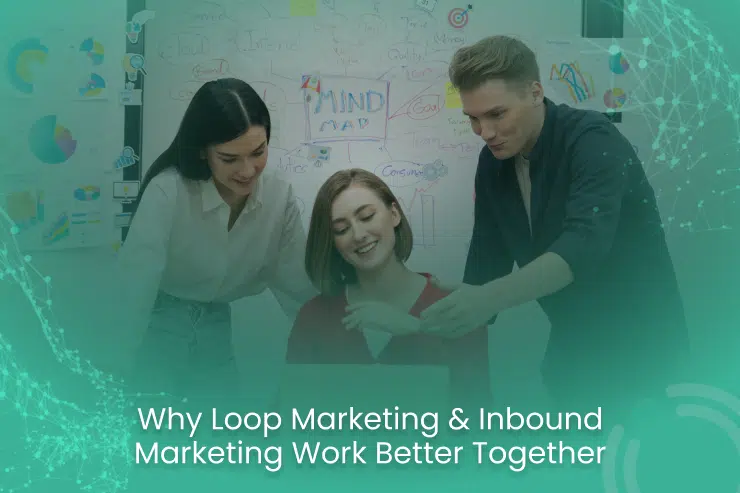

4 Reasons Why Loop Marketing and Inbound Marketing Work Better Together
In the fast-evolving world of digital marketing, we are witnessing a quiet revolution. For over a decade, Inbound Marketing has been the undisputed king of customer acquisition. By creating valuable content tailored to user needs, brands successfully flipped the script on aggressive, intrusive advertising. You built it, you optimized it, and they came.
But today, getting customers through the door is only half the battle.
As acquisition costs skyrocket and consumer trust hits all-time lows, relying solely on a linear funnel is a risky strategy. What happens after a prospect converts? If your marketing strategy stops at the purchase confirmation page, you are leaving massive amounts of revenue on the table.
This is where Loop Marketing comes in. By merging the data-driven, customer-centric methodology of Inbound Marketing with the self-sustaining momentum of Loop Marketing, brands can create a powerful growth engine.
Let’s dive into why these two strategies are highly effective on their own, and why loop marketing and inbound marketing work better together.
Understanding the Duopoly: Inbound vs. Loop Marketing (http://www.osits.official)
To understand why they work so well together, we first need to look at what each brings to the table.
1. Inbound Marketing: The Magnet
Inbound marketing is the art of attracting customers by creating valuable content and experiences tailored to them. Instead of shouting at a crowd (outbound), inbound whispers to the individual who is already looking for a solution.
It relies heavily on:
-
Search Engine Optimization (SEO): Being visible when answers are needed.
-
Content Marketing: Blogs, ebooks, and videos that solve genuine pain points.
-
Social Media Engagement: Building community and brand awareness organically.
The traditional inbound journey is often visualized as a funnel: Attract Engage Delight. If you are new to building these systems, explore our step-by-step blueprint on how to build an inbound marketing strategy from scratch to establish your foundational content assets.
2. Loop Marketing: The Flywheel
Loop marketing (often associated with growth loops) rejects the linear nature of the funnel. In a traditional funnel, you pour cash and effort into the top, and a small percentage of customers drop out of the bottom. Once they buy, the process resets, requiring you to spend more money to attract new prospects.
Loop marketing views growth as a closed circuit. It focuses on creating mechanisms where the output of one cycle becomes the input for the next.
A Classic Example: A user signs up for a project management tool (Inbound). To collaborate, they must invite three teammates (Loop). Those three teammates sign up, discover the value of the tool, and eventually invite their own teams. The product organically markets itself.
To see this in action at enterprise scale, you can read Reforge’s breakdown of viral growth loops which pioneered how modern technology companies scale without traditional ad budgets.
The Core Problem with the Traditional Funnel
The traditional marketing funnel is fundamentally leaky. It operates on a transaction-based mindset:
[ Attract ] --> [ Engage ] --> [ Convert ] --> [ End of Journey ]
When your primary focus is just filling the top of the funnel (ToFu), you become trapped on an acquisition treadmill. You have to constantly pump money into paid ads, SEO content, and lead generation campaigns just to maintain a steady baseline of sales.
Furthermore, a funnel treats customers as an outcome. Once the sale is closed, the customer is handed off to customer success, and marketing washes its hands of them. This siloed approach creates a disjointed user experience and ignores your most valuable asset: your existing customer base.
To combat this loss of momentum, many brands are transitioning away from strict pipelines. Review our complete tactical breakdown of the funnel vs flywheel framework to see how your operational reporting metrics need to change.
Why Inbound and Loop Marketing Need Each Other
When you marry Inbound and Loop Marketing, you replace the leaky funnel with a self-sustaining Growth Flywheel. Inbound provides the initial spark and fuel, while Loop Marketing builds the engine that keeps the momentum going without requiring infinite ad spend.
       [ Inbound Content ]
               │
               ▼
       ┌───────────────┐
  ◄────│  User Action  │◄────┐
  │    └───────────────┘     │
  │            │             │
  │            ▼             │ (The Loop)
  │    ┌───────────────┐     │
  │    │ Product Value │     │
  │    └───────────────┘     │
  │            │             │
  │            ▼             │
  │    ┌───────────────┐     │
  └═══►│ Advocacy/Share│════─┘
Here is exactly why these two methodologies are soulmates for modern business growth.
1. Inbound Solves Loop Marketing’s Cold Start Problem
Loop marketing is brilliant, but it has a major vulnerability: it requires initial mass. A viral loop or a referral program cannot trigger itself if there are no users in the ecosystem to begin with.
Inbound marketing solves this “cold start” problem beautifully. By leveraging targeted SEO, high-value lead magnets, and authoritative thought leadership, inbound drives the exact, high-intent audience you need to kickstart your loops. Inbound brings the spark; the loop catches the fire.
2. Loop Marketing Multiplies Inbound ROI
Creating high-quality content is expensive and time-consuming. If an inbound blog post costs $500 to produce and brings in 10 customers, your Customer Acquisition Cost (CAC) is $50.
But what if 3 of those 10 customers are prompted by a loop mechanism to share their achievements on LinkedIn, inviting their networks to try your tool? Suddenly, those 10 customers bring in 5 more. Your original $500 investment has now netted 15 customers, dropping your CAC significantly and maximizing the ROI of your inbound efforts.
3. It Transforms “Delight” into an Actionable Growth Lever
In the classic inbound flywheel model popularized by HubSpot’s inbound methodology, “Delight” is often treated as a soft metric—keeping customers happy so they don’t churn.
Loop marketing turns “Delight” into a structured, measurable growth weapon. It builds specific features and prompts into the user journey so that a delighted customer is given an easy, incentivized pathway to advocate for the brand.
4 Synergistic Loops You Can Build Today
To practicalize this concept, let’s look at how you can blend inbound content with loop mechanisms across your marketing ecosystem.
Type 1: The Content-to-Share Loop
-
The Inbound Element: You write an incredibly thorough, data-backed industry report that addresses a massive pain point in your niche.
-
The Loop Element: To download the full interactive dashboard or templates associated with the report, users are encouraged to share a specific stat directly to social channels with one click. Their peers see the stat, click the link, read the inbound post, and repeat the cycle.
Type 2: The User-Generated Content (UGC) Loop
-
The Inbound Element: You run a community forum, a specialized educational portal, or a review site that ranks highly on Google for long-tail keywords.
-
The Loop Element: New users arrive via search engines to read answers provided by existing users. To ask their own questions or unlock advanced features, they must create an account. Their subsequent participation creates newindexable web pages that rank on Google, drawing in the next wave of organic searchers. (Think Quora or Stack Overflow).
Type 3: The Referral/Incentive Loop
-
The Inbound Element: A user finds your SaaS tool through an optimized piece of content explaining “How to streamline remote team communication.” They sign up for your free tier.
-
The Loop Element: Inside the app, an onboarding prompt offers them premium features for 30 days if they invite a teammate. The inbound content set the expectations and established the value, making the user highly receptive to inviting others to share that value.
Type 4: The Network Effects Loop
-
The Inbound Element: You attract B2B buyers through targeted webinars and case studies demonstrating how your software automates contract signing.
-
The Loop Element: When a customer uses your platform to send a contract, the recipient receives an email saying: “Signed via BrandX.” Intrigued by the seamless signing experience, the recipient signs up for their own account.
Step-by-Step: How to Integrate Both into Your Strategy
If you want to transition your marketing from a linear funnel to a unified inbound-loop engine, follow this blueprint:
Step 1: Map the User Journey Beyond the Sale
Document your current customer journey. Where does your marketing team stop tracking? If it stops at “Leads Handed to Sales” or “Closed Won,” you need to expand your map. Identify key moments in the post-purchase experience where a customer feels a surge of satisfaction (e.g., first successful project launch, hitting a milestone, receiving their package).
Step 2: Identify Loop Triggers for Happy Customers
Look at those moments of high satisfaction and insert a loop trigger.
-
Can they share a milestone graphic to social media?
-
Can they invite a collaborator?
-
Can they write a quick review in exchange for loyalty points?
Step 3: Optimize Inbound Content for Retaining, Not Just Attracting
Shift a portion of your inbound content strategy toward existing customers. Write advanced tutorials, product update breakdowns, and customer success stories. If you need inspiration on content styles, read our guide on how to write high-converting retention content to keep your current users engaged.
When your current users see that you are continuously providing value even after you have their money, their loyalty solidifies, making them much more likely to engage with your growth loops.
Step 4: Measure “Velocity” Along with Conversion Rates
In a funnel system, you measure conversion rates between stages. In an integrated loop system, you must also measure velocity—how fast a user moves from discovering your inbound content to triggering a loop that brings in a new user. The faster this cycle completes, the faster your business scales exponentially.
Final Thoughts: The Future Belongs to Connected Systems
The digital landscape is too competitive to rely on a strategy that forgets the customer the moment their credit card clears.
Inbound marketing is unparalleled at establishing trust, building brand equity, and drawing an audience of highly qualified prospects to your doorstep. Loop marketing ensures that once those prospects arrive, their energy, networks, and satisfaction are captured and redirected back into the business to drive further growth.
Stop treating your marketing tactics as independent, linear tasks. Connect your inbound efforts to organic growth loops, and watch your marketing evolve from an expensive chore into a self-sustaining ecosystem.
What do you think? Is your brand currently stuck on the acquisition treadmill, or have you successfully implemented growth loops in your marketing strategy? Let us know in the comments below! http://www.osits.official
Related posts
OSITS • January 16, 2026
11 Proven Paid Social Advertising Strategies That Drive Real Results in 2026

OSITS • January 16, 2026
7 Proven Tips to Reduce Marketing Agency Cost & Maximise ROI in 2026 | OSITS
OSITS • January 14, 2026
7 Powerful Differences Between Organic vs Paid Social Media in 2026 | OSITS
OSITS • January 14, 2026


