
Fast-moving consumer goods companies in Pakistan run on razor-thin margins, high sales volumes, and distribution networks that can stretch across dozens of cities. A dedicated FMCG ERP system is what allows these businesses to keep control of stock, pricing, and distributor performance without drowning in spreadsheets. If you manufacture or distribute fast-moving goods and you’re still reconciling inventory manually at month end, this guide walks through what an FMCG ERP system actually does, the modules that matter most, and how to choose one that fits the realities of doing business in Pakistan.
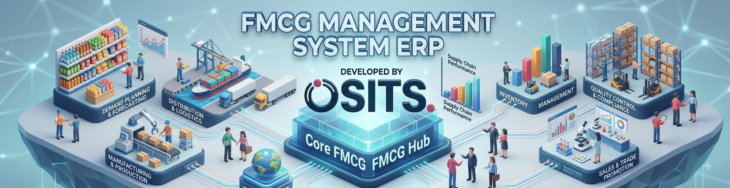
What Makes FMCG Different From a Generic ERP Use Case
Most generic accounting or ERP software is built around a single warehouse and a handful of stock-keeping units. FMCG businesses are the opposite: hundreds or thousands of SKUs, short shelf lives, frequent promotions, and a multi-tier distribution chain running from factory to distributor to retailer to consumer. A system that isn’t purpose-built for this volume and velocity tends to break down in three predictable places — inventory accuracy, pricing consistency, and visibility into what’s actually happening at the distributor and route level.
The Three Pressure Points Every FMCG Business Feels
- Batch and expiry tracking — perishable or time-sensitive goods need FIFO/FEFO stock rotation, and manual tracking almost always leads to write-offs.
- Distributor and route visibility — without real-time data from the field, head office finds out about stock shortages or overstocking days after it matters.
- Pricing and scheme management — trade promotions, volume discounts, and seasonal pricing are hard to apply consistently across a large sales force without a system enforcing the rules.
Core Modules of an FMCG ERP System
When evaluating an FMCG ERP system, the feature list matters less than whether these specific modules work well together:
1. Inventory and Warehouse Management
Real-time stock visibility across multiple warehouses, batch and expiry tracking, and automated reorder points are the baseline. For FMCG specifically, the system should support FEFO (first-expiry-first-out) picking logic, not just FIFO, since expiry dates — not just arrival dates — determine what should move first.
2. Sales and Distribution Management
This covers order booking (often via a mobile app for field sales officers), route planning, secondary sales tracking to distributors and retailers, and integration with van/pre-sales operations. A good system gives head office same-day visibility into what was sold, where, and by whom.
3. Pricing, Schemes, and Promotions
FMCG companies run constant trade schemes — buy-three-get-one, seasonal discounts, slab-based pricing by volume. The ERP should let you configure these centrally and apply them automatically at the point of order, rather than relying on sales staff to calculate them manually.
4. Financial Accounting and Compliance
General ledger, accounts receivable/payable, and — increasingly important for Pakistani businesses — integration with FBR’s digital invoicing requirements. An ERP that can generate compliant invoices directly reduces the risk of penalties and manual re-entry.
5. Reporting and Demand Forecasting
Centralized dashboards that pull data from inventory, sales, and finance let management see which SKUs are moving, which distributors are underperforming, and where working capital is tied up in slow-moving stock.
Benefits of Implementing an FMCG ERP System
Businesses that move from manual or fragmented systems to a proper FMCG ERP system typically see improvements in a few consistent areas:
- Reduced stock write-offs from expired or obsolete inventory
- Faster order-to-delivery cycles through automated workflows
- More consistent pricing and fewer scheme-related disputes with distributors
- Better cash flow visibility through real-time receivables tracking
- Data-backed demand forecasting instead of gut-feel purchasing decisions
None of these benefits are automatic — they depend on clean data entry, proper training, and a system that’s actually configured around your distribution model rather than a generic template.
Cloud vs On-Premise for FMCG Businesses in Pakistan
Cloud-based FMCG ERP systems have become the more practical choice for most mid-sized Pakistani distributors and manufacturers, mainly because they let field teams and remote warehouses access the same live data without maintaining local servers at every location. On-premise systems can still make sense for larger manufacturers with existing IT infrastructure and strict data residency requirements, but for most FMCG businesses, the lower upfront cost and easier multi-location access of cloud ERP outweigh the trade-offs.
Common Mistakes When Choosing an FMCG ERP System
A few patterns show up repeatedly in failed or underperforming ERP rollouts:
- Choosing a generic accounting package and trying to bolt on FMCG-specific workflows later
- Underestimating the training needed for field sales staff who will use mobile order-booking apps
- Not migrating historical sales and inventory data properly, which breaks demand forecasting for the first year
- Ignoring local compliance requirements like FBR digital invoicing until it becomes urgent
Working with a local implementation partner who understands both the software and Pakistan’s regulatory environment usually prevents most of these issues.
How to Evaluate FMCG ERP Vendors
When shortlisting vendors, ask for a demo using your actual SKU list and distribution structure rather than a generic sample dataset. Confirm whether batch/expiry tracking, scheme management, and mobile order booking are native features or third-party add-ons, since add-ons often mean slower support and higher long-term cost. Finally, ask specifically how the system handles FBR digital invoicing integration, since this is now a practical requirement rather than a nice-to-have for businesses operating in Pakistan.
Getting Started
If your FMCG business is still running on spreadsheets, disconnected accounting software, or a system that was never designed for high-SKU, multi-tier distribution, the cost of switching is almost always lower than the cost of continuing to operate blind. A properly implemented FMCG ERP system pays for itself through reduced write-offs, tighter distributor accountability, and cleaner financial reporting alone — well before you count the time saved on manual reconciliation. OSITS designs and implements ERP solutions tailored to FMCG distribution and manufacturing businesses in Pakistan, with local support and configuration built around how your business actually sells and moves stock.
Get a Free ERP Software Consultation
If you are evaluating ERP software for your business in Pakistan, talk to OSITS before making any decision. Our free consultation includes an honest assessment of your current systems, a recommendation of the right modules for your industry, and a transparent cost estimate — with no sales pressure.
About OSITS: OSITS is a sister company of Progatix, Pakistan’s leading software house. Headquartered in Karachi with offices in Islamabad, the Progatix group has delivered ERP, SaaS, payroll, and cloud solutions to 300+ clients including SMC, Popular Group, Fossil, Clover, Sunco, Meezan Bank, KFC Pakistan, Gul Ahmed, and Nishat Group since 2003. Learn more at progatix.com.
20+ years · 300+ clients · Local support in Karachi & Islamabad
📍 Offices in Karachi & Islamabad
🌐 www.osits.pk/contact-us
📞 0333-2290299
📞 021-3-5293284-86
Published by OSITS — Pakistan’s trusted ERP software house since 2003. Specialists in cloud ERP, payroll software, FBR digital invoicing integration, and custom software development for Pakistani businesses.
OSITS is a proud sister company of Progatix, sharing the same commitment to reliable, high-quality technology solutions for businesses across Pakistan.
Related posts

OSITS • August 13, 2026


